Understanding PCR in Consumer Health Packaging: What Brands Need to Know
Insights
Reading time: 3 minutes
Discover how post-consumer recycled (PCR) content can be safely and confidently integrated into consumer health packaging. Learn how advanced recycling, mass balance and certified materials help brands protect product performance while preparing for upcoming PPWR requirements.
Discover how post-consumer recycled (PCR) content can be safely and confidently integrated into consumer health packaging. Learn how advanced recycling, mass balance and certified materials help brands protect product performance while preparing for upcoming PPWR requirements.
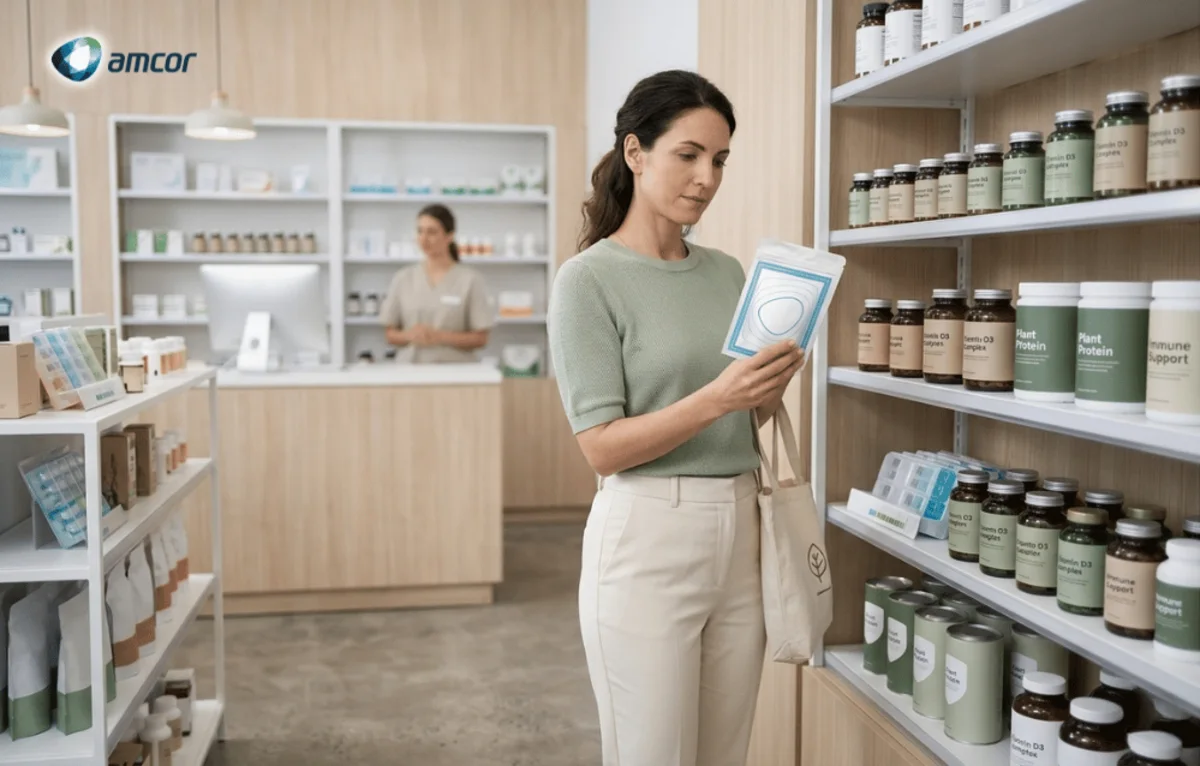
Consumers increasingly expect packaging that is safe, responsible and designed with circularity in mind. Awareness of recycled plastics is now mainstream: 91% of European shoppers know that packaging can contain recycled plastic, and 76% have consciously purchased products with recycled content.1 For consumer health brands, this shift indicates increasing consumer interest in packaging that integrates recycled content.
As the EU Packaging and Packaging Waste Regulation (PPWR) moves toward mandatory PCR levels, many brands are exploring how to introduce certified post-consumer recycled (PCR) content into their packaging, especially for products that require the highest levels of protection, such as vitamins, supplements, probiotics and nutritional formats.
Read on for a simple guide to help you understand what PCR means for your packaging and how it can support your long-term strategy.
What PCR Means for Flexible Packaging
PCR (post-consumer recycled) material comes from packaging and products that have reached the end of their useful “life” and are collected, mostly from households, for recycling. Mechanical recycling uses washing and grinding to convert this material into new plastic pellets suitable for many packaging components. However, because small traces of previous content may remain, mechanical PCR is typically used for non-food contact layers or secondary packaging.
For primary packaging that is in contact with the food product, strict EU food contact rules apply. These formats require materials that meet the highest purity and safety standards.
Advanced (chemical) recycling plays an important role
This technology uses very high heat to break down plastic into its basic building blocks and can achieve quality and safety levels comparable to virgin materials, making it suitable for food-contact packaging. Since the new material is chemically identical to virgin material, the percentage of recycled content is tracked and certified using mass balance accounting. For your brand, this means that you can integrate certified PCR while maintaining the protection, shelf life and product safety your consumers rely on.
Why Mass Balance Matters and How It Helps You
In advanced recycling, recycled and virgin feedstocks mix within the production process and cannot be physically separated. Mass balance is an internationally recognized method that provides transparent accounting. It tracks how much PCR enters the system and allocates the same proportion to the final material.2
For you, mass balance offers two important advantages:
1. Flexibility to Meet PPWR Requirements
The PPWR sets mandatory minimum PCR levels for plastic packaging from 2030. For flexible packaging, mass balance allows you to start integrating certified PCR today and scale up over time as advanced recycling capacity expands.
2. Verified, Responsible Claims
Certification schemes such as ISCC PLUS can support responsible communication by confirming that the recycled content is trackedthrough mass balance accounting.
Certification gives your brand the confidence to communicate recycled content with clear, verifiable evidence. It also offers a practical, future-ready path to meeting PPWR requirements without disrupting your product portfolio.
For a visualization of what mass balance accounting looks like, check out our infographic.
Rigid Plastic Packaging and PCR: What You Need to Know
Rigid plastic packaging can incorporate recycled materials from mechanical or chemical recycling, as long as the packaging stays safe, strong and suitable for the product. When companies use mass balance methods, the recycled content is counted in the system but not always physically inside the package, so claims must state this clearly.
Mechanical recycling is common for everyday HDPE, PP and PET bottles and containers. These can safely include recycled content, although PET items may look slightly different in clarity or color. Chemical recycling can produce recycled plastic that looks and performs like new, making it suitable for products that need very pure materials.
Caps, lids and other small parts can also include recycled content, but because they often use several materials, brands should clearly explain how the recycled content is assigned. Regardless of the recycling method, all packaging must pass strict tests to ensure it stays strong, does not leak and works well with the product inside.
What about “CleanStream®” technology and recycled polypropylene material?
Mechanical recycling works by breaking down plastic waste and reprocessing it without changing the plastic’s chemical structure. The process includes collecting, cleaning, shredding, melting and reshaping the plastic into new items. It’s the most common and well-established recycling method in places that have good collection and sorting systems. However, it has limits: the plastic loses quality each time it’s recycled because heat and processing wear it down, and it only works well when the waste is clean and properly sorted.
CleanStream® takes mechanical recycling much further. Instead of relying on basic sorting, it uses multiple, highly precise washing and sorting steps to separate materials and achieve extremely high levels of purity. This allows it to turn household plastic waste into high-quality, lower-carbon recycled plastic that can be used in more sensitive applications, something traditional mechanical recycling struggles to do.
Ready to Make Your Packaging PPWR-Ready? Let’s Talk.
Our packaging experts are here to support you.
We can help you explore how PCR fits into your packaging strategy and design solutions that protect your product, your consumers, and your brand, all while preparing for PPWR requirements.
Get in touch with our packaging experts to start your PPWR-ready packaging journey.
You can also subscribe to our newsletter for the latest sustainability and industry updates.
Related Insights
How Are Regulations and Trends Reshaping Consumer Health Packaging?
Consumer health packaging plays a critical role in product safety, compliance and consumer trust. Download this free e-book and get a clear, practical overview of the key trends and regulatory developments affecting consumer health packaging.
Consumer health packaging plays a critical role in product safety, compliance and consumer trust. Download this free e-book and get a clear, practical overview of the key trends and regulatory developments affecting consumer health packaging.
PPWR and Consumer Health Packaging: Your 2026 Guide
The EU’s Packaging and Packaging Waste Regulation (PPWR) will impact consumer health packaging, introducing strict PFAS restrictions, recyclability criteria and mandatory post-consumer recycled (PCR) content for products such as nutraceuticals, vitamins and supplements. What does the PPWR mean for your brand? What changes should you be aware of?
The EU’s Packaging and Packaging Waste Regulation (PPWR) will impact consumer health packaging, introducing strict PFAS restrictions, recyclability criteria and mandatory post-consumer recycled (PCR) content for products such as nutraceuticals, vitamins and supplements. What does the PPWR mean for your brand? What changes should you be aware of?
EPR Fees for Consumer Health Packaging: What You Need to Know in 2026
Learn how Extended Producer Responsibility (EPR) fees influence consumer health packaging costs, compliance requirements and design decisions. A practical guide for consumer health brands preparing for evolving EU regulations.
Learn how Extended Producer Responsibility (EPR) fees influence consumer health packaging costs, compliance requirements and design decisions. A practical guide for consumer health brands preparing for evolving EU regulations.