Internet fans have called it "the duct tape of science,” but what makes Parafilm® M so versatile?
History
Reading time: 2 minutes
When you find something good, there’s no substitute or knock-off that will ever really live up to the real deal.
And since its launch in the 1930’s, Amcor’s Parafilm® M has maintained its spot as the world’s most trusted, all-purpose laboratory film, but how?
When you find something good, there’s no substitute or knock-off that will ever really live up to the real deal.
And since its launch in the 1930’s, Amcor’s Parafilm® M has maintained its spot as the world’s most trusted, all-purpose laboratory film, but how?
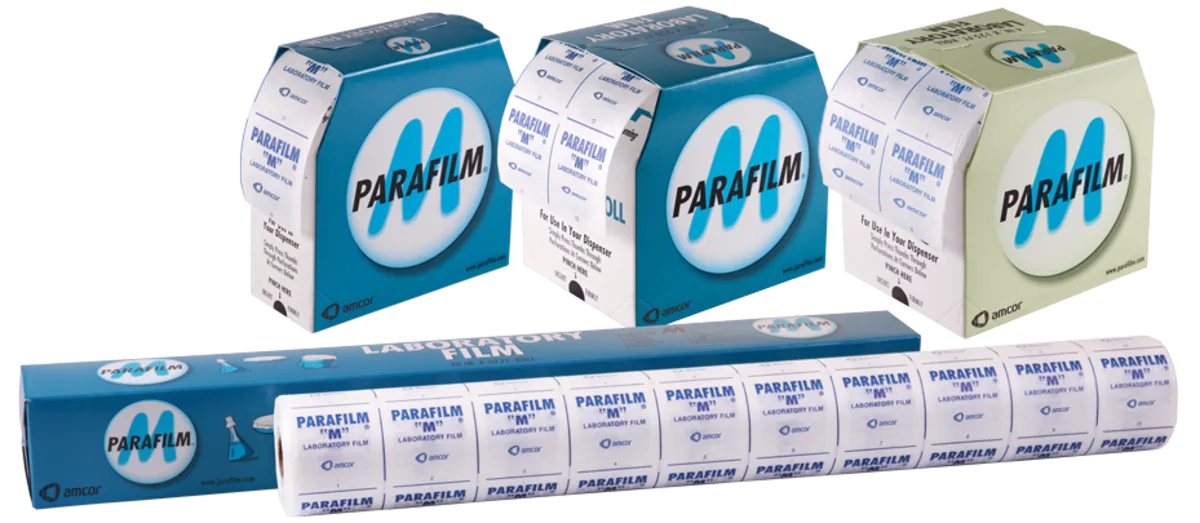
Parafilm® M—nearly a century of all-around lab goodness
What started as a map-mounting adhesive film and moisture-proof wrapping quickly found a multitude of uses, ranging from preventing banana crown rot and resealing wine bottles to keeping contaminants out of laboratory experiments.
In October 1933, Allen Abrams and Charley L. Wagner of Marathon Paper Mills Company filed a patent for a paraffin-wax-based paper that was non-tacky at room temperature but self-adhesive when heated. A few uses listed in the patent application included surgical wrapping, horticultural binding tape and cheese packaging. In September 1936, Parafilm® M was officially patented.
It wasn’t until the 1950s that Parafilm® M entered the science scene—and quickly became a lab staple ever since.

In 1956, the Marathon Paper Mills Company sold its Wisconsin-based plant to the American Can Company. In the 1990s, Pechiney Plastic Packaging, Inc. acquired American Can, and was later acquired by Alcan. In 2010, Curwood, a division of Bemis Company, acquired Alcan. In 2019, Amcor acquired Bemis, and continues to manufacture Parafilm® M in Neenah, Wisconsin using nearly the same formulation from the 1930s.
The “para” in the name comes from the paraffin wax that is used to make the film. The meaning of the “M” has been widely debated online, and we’re here to shed some light on what it stands for. This lab-favorite has uses beyond the lab, and originally came in four types:
- Parafilm F for floral – now available in Floratape® Original Florist Stem Wrap and Parafilm® Florist Stem Wrap
- Parafilm G for horticulture grafting – now available in Parafilm® Nursey Grafting Tape
- Parafilm C for cheese packaging – while this is no longer offered, Amcor does have a full portfolio of cheese packaging options
- Parafilm M for mounting maps – now a lab staple and agricultural film
The secret behind the versatility of Parafilm® M
Drum roll, please... it’s the proprietary blend of waxes and polyolefins that makes it permeable to oxygen and carbon dioxide yet resistant to moisture loss and absorption.
While we can’t reveal the exact mix of waxes that have been used since it launched in the 1930s, we can tell you more about how Parafilm® M is resistant against many polar substances and outperforms other lab films on the market.
Film testing was coordinated by the Amcor Flexibles North America Corporate Lab using samples of Parafilm® M versus market-related competitor film intended for the same use in a lab environment. While there were minimal differences between the competitor and Parafilm® M films regarding isopropanol and ethanol transmission rates, the competitor films had 800% higher oxygen, 680% higher water vapor and 35% higher heptane transmission rates than Parafilm® M.
Parafilm® M offers reliable protection. It’s predictable oxygen transmission rates (OTR) and high-performing, self-activating seals keep your experiments and tests consistent, which helps improve your success rates. That means you can keep your sensitive and costly data well-protected with the world’s most trusted, all-purpose lab film.
What’s next for Parafilm® M?
The formulation has remained virtually unchanged, and Parafilm® M has earned its spot as a lab staple—right alongside lab coats, safety goggles and the metric system—but that doesn’t mean we plan to stop innovating.
“Parafilm's reputation as the market leader didn’t happen by chance, but through consistent performance and reliability,” said Ally Ostrander, Account Manager, Parafilm®, Amcor Flexibles North America. “We plan to retain our position as the laboratory film leader by continuing to invest in innovation, quality and customer collaboration.”
As the market leader in all-purpose laboratory film, Amcor is constantly pursuing ways to set the standard with Parafilm® M.
Learn more about Parafilm® M All-Purpose Laboratory Film below.