Doing More with Less: Rethinking Bulk Foodservice Packaging
Innovation
Reading time: 2 minutes
The foodservice industry is under pressure to do more with less — less cost, less waste, less storage space. We spoke to Giorgio Dini, Marketing Manager, Culinary, at Amcor Flexibles EMEA, about how a recycle-ready pouch is changing the game for bulk foodservice brands across Europe.
The foodservice industry is under pressure to do more with less — less cost, less waste, less storage space. We spoke to Giorgio Dini, Marketing Manager, Culinary, at Amcor Flexibles EMEA, about how a recycle-ready pouch is changing the game for bulk foodservice brands across Europe.
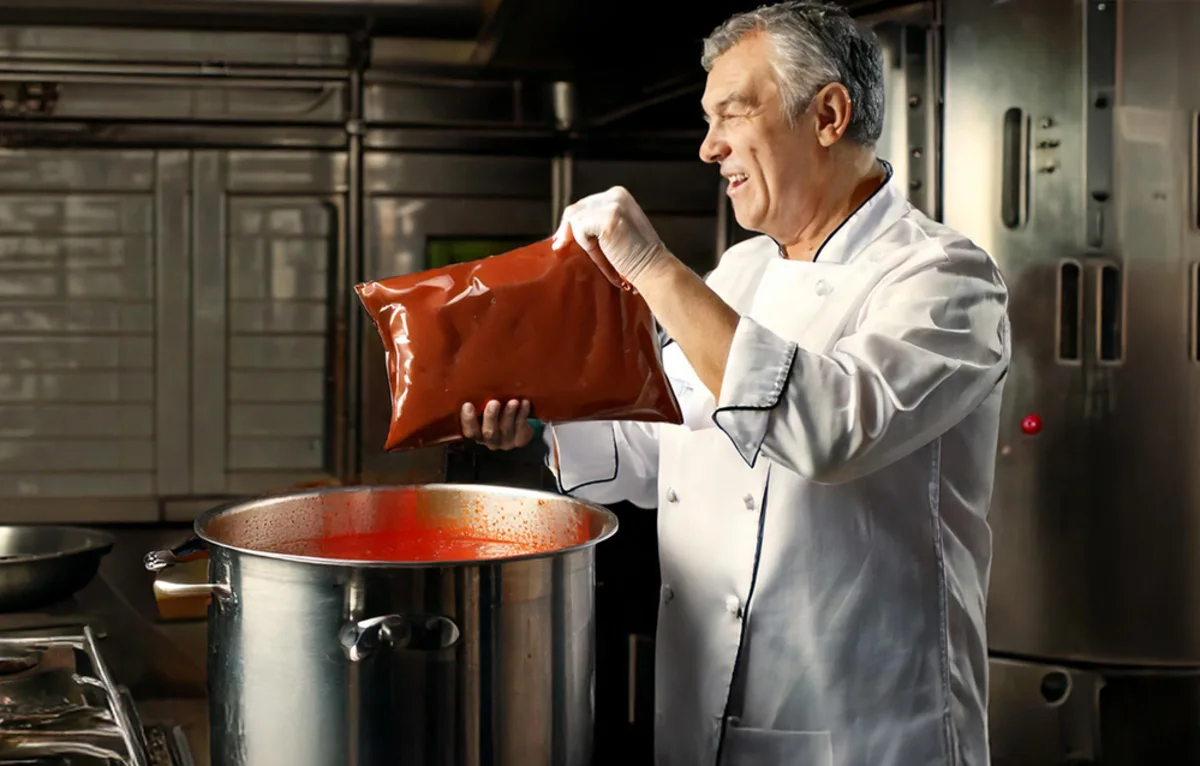
Giorgio, what is Liquiflex® AmPrima® and who is it for?
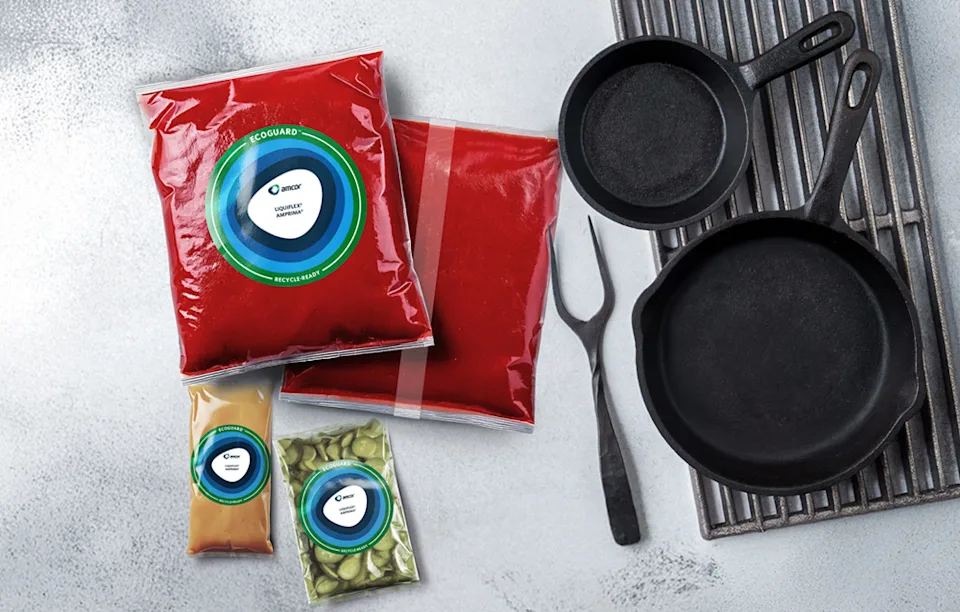
Liquiflex® AmPrima® is a mono-material, recycle-ready pouch designed for bulk foodservice packaging like sauces, dressings, frozen vegetables, soups, proteins and all the high-volume products that commercial kitchens, caterers and restaurant chains rely on daily.
We developed Liquiflex® AmPrima® to expand the range of packaging solutions available to the foodservice sector. Alongside traditional formats such as cans and pails, it provides a flexible, lightweight option that can help reduce packaging weight and optimize storage and transportation efficiency.
How does the pouch help with storage, a big concern for foodservice operators?
It's one of the first things our customers notice. Before filling, our reels of film take up very little storage space. Once filled, it is possible to get more product per pallet and lower transportation costs. Moreover, headspace can be better calibrated with Liquiflex. For brands and caterers managing tight margins and limited warehouse capacity, that efficiency adds up fast.
Foodservice operators are looking for ways to reduce their environmental impact without compromising performance. How can packaging help?
Improved sustainability was central to the design of Liquiflex® AmPrima® from day one. As a mono-material solution, the pouch is recycle-ready in European countries with established flexible polyethylene (PE) recycling streams.
The environmental benefits are significant. Compared with heavier packaging formats, Liquiflex® AmPrima® can deliver a carbon footprint reduction of up to 79%, a 75% reduction in non-renewable energy use and an 84% reduction in water consumption.¹ These figures are based on Amcor's ASSET life cycle assessment methodology, assured by The Carbon Trust.
Importantly, these sustainability gains come without compromising the product protection and convenience that foodservice operators expect. In addition, our customer often see improvement of the efficiency of the production process.
Many foodservice and food manufacturing businesses are concerned about the impact of upcoming packaging regulations. How do you help address those concerns?
We design our products to help brands prepare for packaging requirements while maintaining operational efficiency. The EU's Packaging and Packaging Waste Regulation (PPWR) introduces strict limits on PFAS in food packaging as of August 2026. And from January 2030, the PPWR mandates for plastic packaging to incorporate a minimum percentage of post-consumer recycled (PCR) content.
Engineered with these requirements in mind, Liquiflex® AmPrima® combines a PFAS-compliant, lightweight, recycle-ready design with the flexibility to incorporate food-contact compatible PCR content upon request. This gives brands a practical way to prepare for regulatory requirements while continuing to meet performance expectations.
There may also be financial benefits. The pouch's lightweight design and recycle-readiness can contribute to potential savings on Extended Producer Responsibility (EPR) fees and Plastic Tax² in several countries.
Regulations are also pushing towards refillable dispensers. Can the pouch support that?
It can. New rules are expected to encourage restaurants and hospitality venues to get rid of plastic single serve condiments sachets and refillable dispensers are a great solution in this view.
Liquiflex® AmPrima® can be fitted with fitments like pumps or spout dispensers, turning it into a ready-made refill pack. It's a simple way for operators to stay compliant while keeping things convenient for staff and customers.
This is an opportunity to future-proof your packaging while making immediate gains in efficiency. We're here to help brands make that transition.

¹ Based on Amcor's ASSET Life Cycle Assessment — comparison based on cradle-to-grave analysis of 1-litre pail and 1-litre Liquiflex® AmPrima® pouch. Data valid at time of analysis.
² Amcor's estimation based on modulated EPR per main EU countries (BE, FR, DE, PT, ES).
Ready to make the switch?
To find out how Liquiflex® AmPrima® could work for your foodservice products, get in touch with our team or connect with Giorgio directly.
[Contact us] | [Connect with Giorgio Dini on LinkedIn]
Related Insights
Introducing Liquiflex® AmPrima® for Foodservice in Europe: Recycle-Ready, Space-Saving, Game-Changing
At Amcor, we know the foodservice industry is evolving—and fast. Retailers, caterers, and commercial kitchens across Europe are looking for smarter, more sustainable ways to operate, and we’re proud to be part of that solution.
That’s why we’re excited to officially launch our Liquiflex® AmPrima® pouches in Europe. Following a successful rollout in North America, we’re bringing this...
At Amcor, we know the foodservice industry is evolving—and fast. Retailers, caterers, and commercial kitchens across Europe are looking for smarter, more sustainable ways to operate, and we’re proud to be part of that solution.
That’s why we’re excited to officially launch our Liquiflex® AmPrima® pouches in Europe. Following a successful rollout in North America, we’re bringing this...
Elevating Everyday Staples: Innovations in Condiments Packaging for the Culinary Industry
Condiments like ketchup and mayonnaise are the unsung heroes of our daily dining experiences, adding flavor and zest to our favorite dishes. The packaging of these beloved condiments plays a vital role in ensuring their freshness, quality, and convenience for consumers.
Condiments like ketchup and mayonnaise are the unsung heroes of our daily dining experiences, adding flavor and zest to our favorite dishes. The packaging of these beloved condiments plays a vital role in ensuring their freshness, quality, and convenience for consumers.