5 Things to Know About Processed Cheese Foil, from Amcor Experts
Innovation
Reading time: 3 minutes
Processed cheese portions are a snacking essential enjoyed by millions of consumers, appreciated for their familiar taste, mild texture and spreadability. Packaging plays a key role in this experience, enabling portability, ease of use and the unique benefit of up to a 1-year shelf life. At the center of it is cheese foil, a material that must combine barrier protection, sealing precision, and production efficiency.
Processed cheese portions are a snacking essential enjoyed by millions of consumers, appreciated for their familiar taste, mild texture and spreadability. Packaging plays a key role in this experience, enabling portability, ease of use and the unique benefit of up to a 1-year shelf life. At the center of it is cheese foil, a material that must combine barrier protection, sealing precision, and production efficiency.
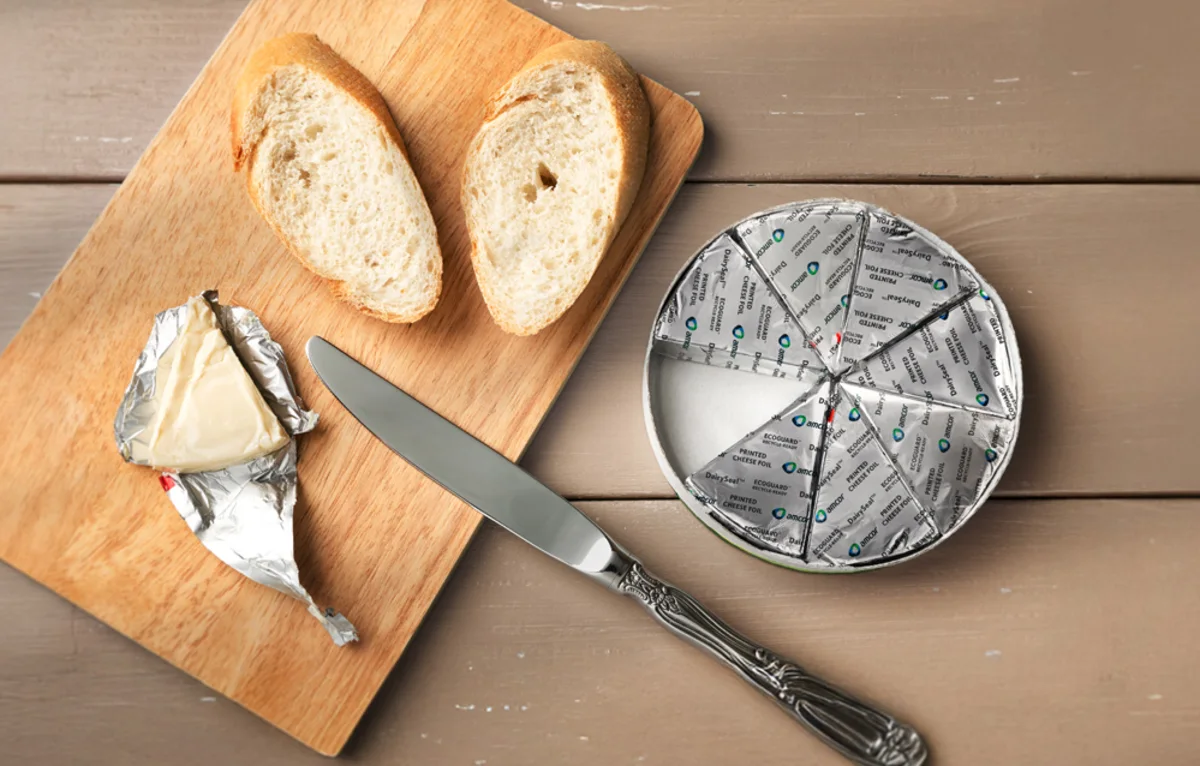
Cheese foil packaging is made of three distinct components: the shell, the lid, and the tear strip. Whether you are looking for a new packaging solution or to optimize your current lines, here are five critical things to know about processed cheese packaging, drawing on Amcor’s expertise and integrated approach.
1. Protection requires more than just aluminium
In the field of processed cheese, packaging is critical to maintain line efficiency (~220 portions per minute) and long shelf life (up to one year).
Because processed cheese is chemically aggressive, it is essential to apply anticorrosion lacquers to the aluminium foil. Without proper protection, corrosion can lead to black spots and pinholes on the foil surface, ultimately causing product deterioration. Amcor offers proprietary lacquering formulations, which means that the lacquers applied to the foil are developed in-house and tailored specifically for performance and enhanced product protection.
However, material protection alone is not sufficient. Long-term product integrity also depends on excellent and consistent seal properties: even the best foil needs the right folding and sealing parameters. This is why Amcor utilizes a proven, systematic Processed Cheese Protocol to evaluate these parameters.
2. Paper label is not a must
Traditionally, processed cheese portions have used unprinted foil, finished with a paper label. While this standard solution remains effective, Amcor's capabilities can open a leaner, more efficient approach.
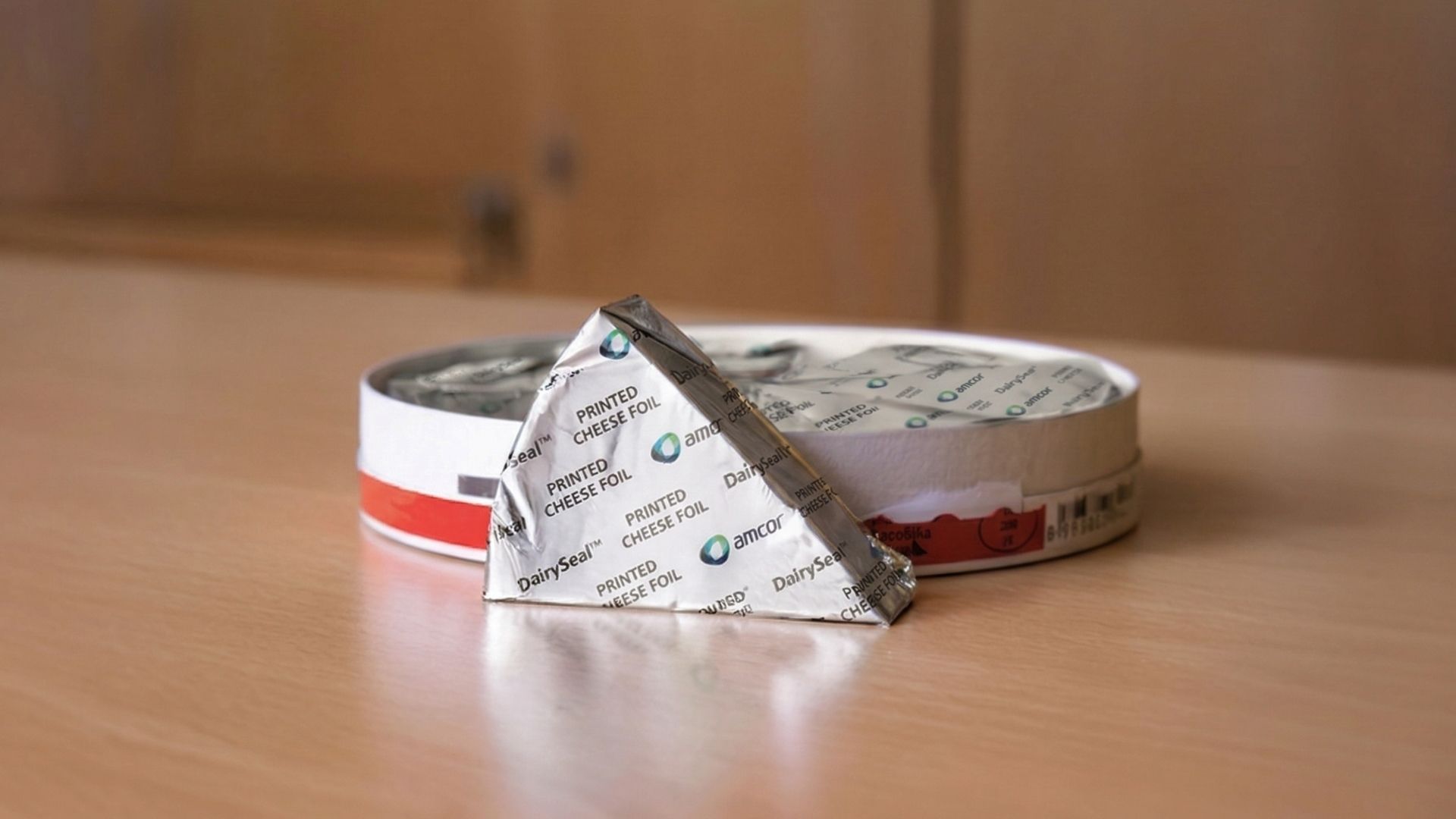
By utilizing direct printing on the cheese foil, such as Amcor’s AmFoil™, manufacturers can completely replace the paper label. With the ability to print up to six colors at our site in Sarrebourg, France, this strengthens branding and visibility, while also delivering major operational and sustainability benefits, such as:
- Improved operational efficiency: Removing the labelling station eliminates a common production bottleneck.
- Simplified material
- Reduced weight: Eliminating the paper label reduces the overall packaging weight.
3. Cheese foil’s sustainability profile can be improved
Both regulations and consumer expectations are evolving, that’s why Amcor enables a streamlined transition process to low-carbon aluminium specifications using a mass balance method. The transition is designed to be seamless for the manufacturer: Amcor calculates the potential CO2 savings, secures the required volume, and obtains third-party certificates for GHG emissions*. At the end of the year, customers receive a self-declaration letter and a mass-balance certificate from an external auditor, proving the committed volumes were successfully supplied.
Amcor also offers third-party certification through the Aluminium Stewardship Initiative (ASI), a global non-profit organization that sets environmental, social, and governance (ESG) standards across the entire aluminium value chain, from bauxite mining to the production of finished packaging. ASI certification ensures that aluminium is responsibly sourced, produced, and managed, with full traceability throughout the supply chain.
Moreover, at the Amcor processed cheese center of excellence, in Froges, France, an advanced Solvent Recovery Unit (SRU) captures, purifies, and reuses solvents instead of disposing of them as waste, reducing costs, lowering the environmental footprint, and improving process sustainability.
4. Amcor, a one-stop solution provider
Cheese foil packaging uses three components: the shell, the lid, and the tear strip. Managing multiple vendors for a single packaged portion adds unnecessary complexity and risk to your operations.
Amcor is one of the few suppliers able to deliver a full solution covering all cheese foil components. This advantage is further strengthened by Amcor’s integrated supply chain of aluminium foil, ensuring greater control, consistency, and reliability.
Supply security is underpinned by Amcor’s global presence and strong European footprint, with three key production sites for processed cheese foil: Froges and Sarrebourg in France, and Teningen in Germany. This multi-site configuration strengthens readiness and flexibility, positioning us to be a reliable and stable partner for our customers. And we recently made new investments in cheese foil production, including a new production line at our Froges site, to enhance capabilities and optimize capacity.
5. On-site support from Field Technical Service is essential
To ensure optimal machinability, Amcor’s Field Technical Service (FTS) team deploys a network of over 120 experts worldwide directly to customer production sites. Operating across all regions, these front-line technical experts work side-by-side with the customer teams to optimize packaging integration, troubleshoot issues, and facilitate smooth transitions.
FTS also acts as the key interface between customer operations and Amcor’s dedicated R&D teams. While R&D team develops innovative structures, materials, and more sustainable solutions in collaboration with our customers, FTS ensures their validation and industrialization on the production line. By translating R&D developments into line-ready applications, FTS helps minimize risk and accelerate implementation.
*in accordance with GHG Protocol, ISO14067 / ISO 22095
Get in touch with one of our cheese packaging experts to explore the best alternatives to your current packs and make data-driven decisions about which packaging option is right for you.
Want to stay up to date on the latest industry trends? Sign up to receive info, invitations to webinars, and updates on packaging sustainability, regulations, and other current topics in packaging.
Related Insights
Forming Films for cheese: Cost efficiency without compromising performance
Explore how Forming Films can elevate your cheese packaging, helping to meet your product protection, efficiency, and sustainability goals.
Explore how Forming Films can elevate your cheese packaging, helping to meet your product protection, efficiency, and sustainability goals.
Gouda Cheese: How to package this Dutch delight
Legend says that Gouda was first discovered by a Dutch farmer who left a wheel of cheese aging longer than intended in the cool, coastal air of Holland. As time passed, the cheese developed a firmer texture and a richer taste, quite different from the fresh cheeses of the time. The farmer shared it with his village, and soon Gouda became a beloved staple. As with many great cheeses, sometimes the...
Legend says that Gouda was first discovered by a Dutch farmer who left a wheel of cheese aging longer than intended in the cool, coastal air of Holland. As time passed, the cheese developed a firmer texture and a richer taste, quite different from the fresh cheeses of the time. The farmer shared it with his village, and soon Gouda became a beloved staple. As with many great cheeses, sometimes the...