Making the switch: A technical Q&A on transitioning to paper pouch for instant coffee
Innovation
Reading time: 3 minutes
Switching to paper packaging doesn’t have to mean compromising on quality or protection. Designed for instant coffee and dry beverages, Amcor’s AmFiber™ Performance Paper stand-up pouch, delivers excellent seal integrity and barrier protection to preserve coffee aroma and taste.
Our technical experts answer common questions about how coffee brands in Europe, Middle East and Africa can make the switch.
Switching to paper packaging doesn’t have to mean compromising on quality or protection. Designed for instant coffee and dry beverages, Amcor’s AmFiber™ Performance Paper stand-up pouch, delivers excellent seal integrity and barrier protection to preserve coffee aroma and taste.
Our technical experts answer common questions about how coffee brands in Europe, Middle East and Africa can make the switch.
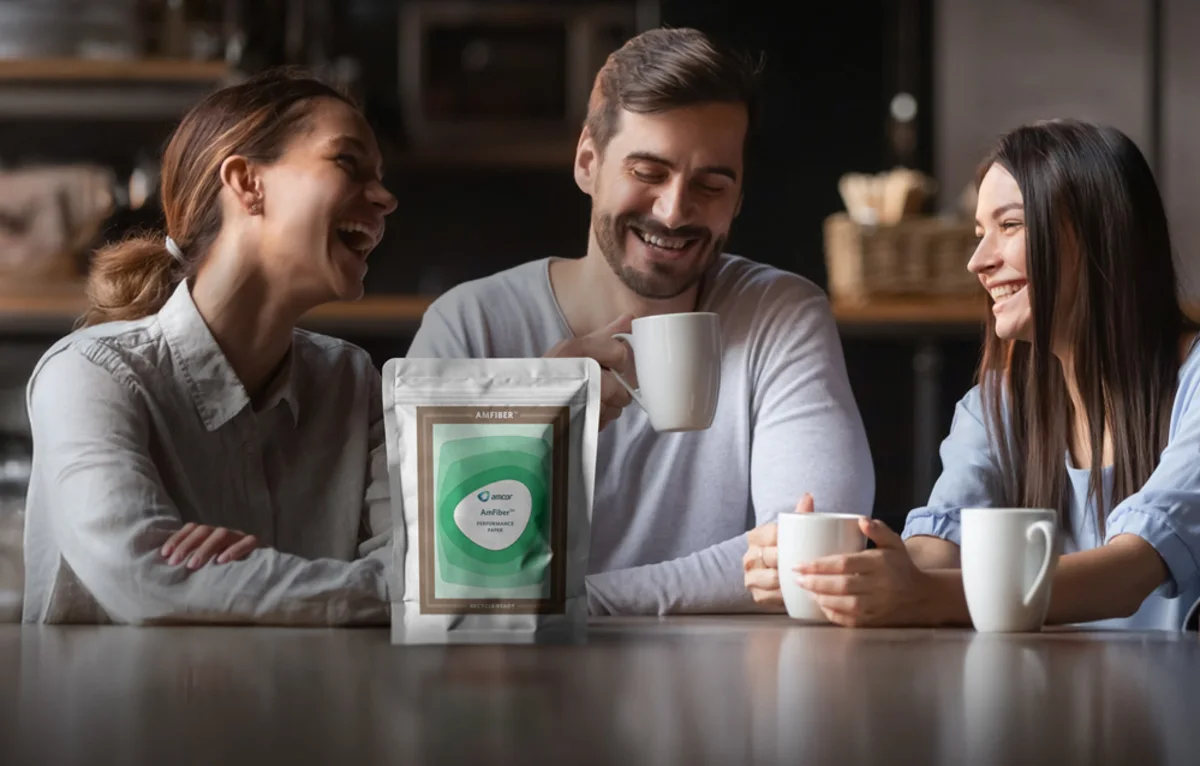
With 85% fiber content and curbside recyclability in several European countries, this certified recyclable pouch (CEPI and Aticelca) for instant coffee and other dry beverages supports brands looking to meet consumer demand for more sustainable packaging.
Curious about what it takes to transition to paper? Our technical field service team is here to guide you every step of the way. Below, Ivan Munoz and Saadet Ekinci, answer some of the most common technical questions about performance and implementation of AmFiber™ Performance Paper for instant and soluble coffee.
What kind of testing is needed with new formats like Amcor’s AmFiber™ Performance Paper stand-up pouches?
Munoz: The AmFiber™ paper format and material are designed to provide a high barrier, which means controlling the sealing integrity is of utmost importance. This has been put to the test in our network of Material Science Centers to ensure that the seal tightness meets the required levels.
We also conduct standard tests on paper packaging for both resistance and humidity to ensure that all materials maintain the right level of moisture and resist heat, oils, and greases.
How does Amcor ensure that AmFiber™ performs well on customers’ existing production lines?
Munoz: AmFiber™ Performance Paper is designed to run efficiently on existing machinery, but we leave nothing to chance and test thoroughly at every stage. We take advantage of our strong partnership with the different machine manufacturers to enable ongoing collaboration and improvement. We also use our own test filling lines at the Amcor Material Science Center in Gent, Belgium. Here, we ensure the full quality and performance of our AmFiber™ paper-based product can be delivered to customers.
What machine adjustments might customers need to make to switch to paper?
Munoz: Switching to paper-based packaging is straightforward – our AmFiber™ solutions are designed to run on customers' existing packing lines with little to no modification. You may only need to fine-tune settings such as sealing, tension, or handling to ensure the best performance and pack quality - which our Field Technical Services team can support you with.
Paper material does not transfer heat as well as plastic. That means you might need to apply a higher temperature to achieve a good seal, and the pressure may also need to be increased. Due to its compact and lightweight design, which facilitates efficient product distribution, there may be other tweaks to make. However, if you do need any machine upgrades to accommodate AmFiber™, they are likely to be minor.
How does Amcor support customers who are switching to paper-based packaging for the first time?
Munoz: Our Field Technical Services team can conduct a pre-assessment of your line to identify any machine upgrades required and any parts that may need to be modified. We will also work hand-in-hand with you throughout the process, from initial trials to full-scale production, to ensure a seamless transition with no glitches.
For example, when a customer in Spain recently wanted to transition from traditional plastic to paper, we first conducted a line pre-assessment and an audit of their machines. Having identified some small modifications that were needed, we connected the customer to our after-market technology partners. Once new parts had been provided and fitted, we went on-site to thoroughly inspect the revised setup and ensure everything was running smoothly.
How does the machine speed of paper-based packaging compare to other materials like plastic?
Ekinci: The assumption is often that a switch to paper-based packaging means a significant sacrifice of run speed, but that’s not necessarily true, you can switch to paper without compromising on machine speed.
The actual run speed of paper pouches varies based on format: for bigger formats we have a line speed of around 40 packs per minute, and for smaller bags we have around 60 packs per minute.
Can customers come to the Amcor Innovation Center Europe to conduct a paper-based packaging trial?
Ekinci: Of course! Our customers are always welcome to come at our Amcor Innovation Center in Gent, Belgium to test the latest developments in paper-based packaging. Our experts will be delighted to show you our test filling lines and perform an AmFiber™ trial for you. We have machines for stand-up pouches, pillow packs, and flow wrap, and we can arrange for you to see them all in action.
Related Insights
Top questions about paper-based packaging – answered by the experts.
Paper-based packaging is gaining momentum as consumers look for packaging choices that align with their preferences. To address the key questions that come with the shift to paper, Amcor experts Daniele Basilici, Regional Product Manager, and Pieter Cools, R&D Manager, share clear, fact-based insights on everything from sealing performance and barrier protection to regulatory changes.
Paper-based packaging is gaining momentum as consumers look for packaging choices that align with their preferences. To address the key questions that come with the shift to paper, Amcor experts Daniele Basilici, Regional Product Manager, and Pieter Cools, R&D Manager, share clear, fact-based insights on everything from sealing performance and barrier protection to regulatory changes.
Leading the way in fiber-based packaging: Insights from Ilya Syshchikov
As interest in fiber-based packaging continues to grow, driven by evolving regulations and shifting consumer expectations, brands across industries are exploring paper as part of their packaging portfolio.
In this video, Ilya Syshchikov, Vice President Global Fiber at Amcor, shares insights on the evolving landscape of fiber-based packaging — touching on key industry trends, technical and...
As interest in fiber-based packaging continues to grow, driven by evolving regulations and shifting consumer expectations, brands across industries are exploring paper as part of their packaging portfolio.
In this video, Ilya Syshchikov, Vice President Global Fiber at Amcor, shares insights on the evolving landscape of fiber-based packaging — touching on key industry trends, technical and...
Dressed to Impress: Coffee Capsule Lidding that gets noticed
Every coffee capsule tells a story — of flavor, aroma, and origin. But before the first drop is brewed, before the aroma fills the air, something else captures the consumer’s attention: the capsule itself. Brands have many options to dress up their coffee capsule lidding for a special occasion, as well as for the daily cup.
Every coffee capsule tells a story — of flavor, aroma, and origin. But before the first drop is brewed, before the aroma fills the air, something else captures the consumer’s attention: the capsule itself. Brands have many options to dress up their coffee capsule lidding for a special occasion, as well as for the daily cup.